
SogoTrade / Wikimedia Commons (Public domain)
Top 10 Online Brokerages in 2026
The world of online brokerages in 2026 isn't just about executing trades—it's about having a financial super-app. The best platforms now offer AI that predicts market trends, fractional shares of real estate and fine art, and banking services with APYs that rival high-yield savings. But with so much noise, how do you choose? We've analyzed the top brokers based on what truly matters: lightning-fast trade execution, asset variety (from stocks to crypto to real assets), low or zero fees, and security that uses your face or fingerprint. Whether you're a newbie looking for robo-advisors or a pro needing global multi-currency access with low FX costs, this ranking cuts through the hype to find the brokerages that deliver real value in 2026.
Top10Grid lets the community re-rank anything — this order is our editors' pick for now; use the buttons below to vote it up or down.

Current Rankings
- –#1
Charles Schwab

Schwab is still the default answer for 'where should I open a brokerage account,' and for long-term investors and retirement savers it's hard to argue otherwise. Stock, ETF, and options trades are commission-free (options carry a small per-contract fee), the Schwab Intelligent Portfolios Premium robo-advisor charges a flat one-time planning fee and nothing ongoing on smaller balances, and the cash management account pays a competitive yield — on top of thousands of no-transaction-fee mutual funds and a serious platform in StreetSmart Edge. Margin rates run higher than some competitors on this list. The one place Schwab genuinely falls short is international trading, where Interactive Brokers' much broader reach into overseas markets leaves it looking parochial.
- –#2
Fidelity Investments

Fidelity continues to dominate with $0 commissions and zero account minimums for standard brokerage accounts. Key features include the Fidelity Crypto offering (trade Bitcoin and Ethereum with 1% spread), the Fidelity Bloom app for automated savings (up to 5% APY on cash), and the Fidelity Basket Portfolios (create personalized index-like baskets for $4.99/month or $0 with $50,000+). The Active Trader Pro platform provides real-time Level 2 quotes and advanced charting. Best for active traders and crypto enthusiasts. Weakness: International trading is limited to select markets and requires manual currency conversion.
- –#3
Interactive Brokers

For anyone trading outside the US, this is genuinely not a close call: Interactive Brokers reaches more than 170 markets worldwide, and IBKR Pro's margin rates undercut Fidelity's and Schwab's by a wide enough margin that it's worth the platform's learning curve. Commissions on US stocks are priced per share, capped as a percentage of trade value, and IBKR Lite offers free trades funded by payment for order flow if you'd rather skip the per-share pricing. Fractional shares, options, futures, forex, and bonds are all supported, and Trader Workstation gives access to algorithmic trading and real risk-management tools most retail platforms don't bother with. It rewards international investors and high-volume traders and punishes anyone who wanted something simple.
Sourcesen.wikipedia.org1 - –#4
Robinhood

Robinhood earned its reputation as the beginner's app, and in 2026 it's still true, but it's grown up around the edges. Trades on stocks, ETFs, options, and crypto are free (crypto priced via spread), and Robinhood Gold, for a monthly subscription fee, adds a boosted APY on uninvested cash, a portion of margin at no interest, and IPO access. Fractional shares, recurring investments, and a cash management account with cashback on its debit card round things out. Margin for Gold members runs higher than on some competing platforms, and the trade-off for that clean mobile-first design is thin research tools, no mutual funds, and support that's still mostly a chat window. Fine for a first brokerage account; less so once your needs get complicated.
- –#5
E*TRADE from Morgan Stanley
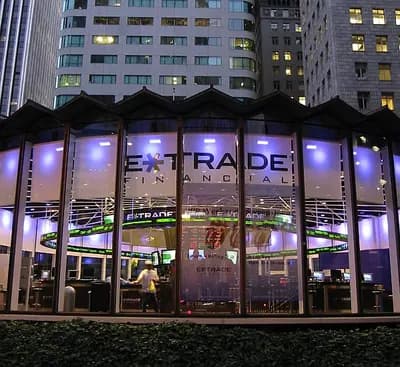
E*TRADE's case rests on two things most competitors can't offer together: Power E*TRADE's options analytics and access to Morgan Stanley's research desk. Stocks and ETFs trade free, options carry a small per-contract fee, and a managed portfolio service is available if you'd rather hand off the decisions for an annual advisory fee. Over 4,400 no-load, no-fee mutual funds and a competitive-yield cash account fill out the rest, with margin rates that scale down as your balance grows. It's built for options traders and people who want institutional-grade research attached to a retail account — crypto isn't native here, so you're routing through a third party if that's part of your plan.
Sourcesen.wikipedia.org1 - –#6
Vanguard Brokerage
Vanguard runs a self-directed brokerage alongside its fund business, giving investors commission-free stock and ETF trades plus access to its own low-cost index funds without transaction fees. It added fractional shares starting at $1 in 2021 and opened its platform to crypto ETFs and mutual funds in December 2025. It's the pick for buy-and-hold investors who want their trading account and their index-fund portfolio under one roof.
Sourcesen.wikipedia.org1 - –#7
SoFi Invest

SoFi Invest makes the most sense as one piece of a bigger SoFi relationship rather than a brokerage chosen on its own merits. Fractional shares start at $1, the robo-advisor charges no management fee, and active members get IPO access; the cash management account offers a competitive APY and pairs with a cashback card when rewards land in a SoFi account. Crypto trading is back after a licensing-driven pause, though pricing is spread-based rather than commission-based. Options trading is available at a basic level, but there's no futures, and research tools feel like an afterthought. This is the brokerage for someone already banking and borrowing through SoFi who wants one app for everything, not someone shopping for the deepest platform.
Sourcesen.wikipedia.org1 - –#8
Merrill Edge (Bank of America)

Merrill Edge exists almost entirely for one audience: Bank of America customers who want their investing folded into the same relationship. The Preferred Rewards program is the real draw, offering a meaningful bonus on rewards credit cards and better savings rates the more you keep combined across accounts, alongside a large lineup of no-fee mutual funds, Merrill's research, and the MarketPro desktop platform for charting. Margin rates scale down with balance size. There's no crypto trading and international access is limited to US-listed ADRs, so this is a strong choice if you're already banking with BofA and a middling one if you're not.
Sourcesmerrilledge.com1 - –#9
Ally Invest

Ally Invest is the quiet, competent option for Ally Bank customers and passive investors who don't need much beyond the basics. Stocks and ETFs trade free, options carry a small per-contract fee, the Managed Portfolios robo-advisor charges 0.30% annually (or nothing on the cash-enhanced version), and there's a broad lineup of mutual funds on the self-directed side. The cash management account and Ally's own high-yield savings both pay competitive APYs, and margin rates scale down with balance size. Research is thin and there's no crypto, and the platform itself feels a step behind flashier competitors — but for someone who already banks with Ally and just wants a place to invest without fuss, it does the job.
Sourcesally.com1 - –#10
Webull

Webull offers $0 commissions on stocks, ETFs, options ($0 per contract), and crypto (spread-based). Standout features include extended hours trading (4:00 AM–8:00 PM ET), real-time Level 2 data, and advanced charting with 50+ technical indicators. The platform supports fractional shares and recurring investments. Webull’s cash management account yields 4.10% APY. Margin rates start at 9.99% for balances under $25,000. Best for active traders and technical analysis enthusiasts. Weakness: Limited mutual fund and bond offerings; customer support is primarily email-based with no phone support.
What Actually Separates These Brokerages Now
Commission-free stock and ETF trades stopped being a differentiator years ago — every platform on this list offers them. What still separates a good brokerage from a great one for a given investor is what happens around the trade: how competitive the cash sweep or money-market yield is on uninvested balances, how deep the research and charting tools go, whether fractional shares and automatic dividend reinvestment are supported cleanly, and how the platform handles the unglamorous stuff like tax documents and account transfers. Two brokerages can look identical on a fee-comparison chart and still be very different to actually use.
How to Choose Between Them
Start with what you're actually going to do with the account. If you're a buy-and-hold investor consolidating retirement and taxable accounts in one place, the bank-scale platforms (Schwab, Fidelity, Merrill Edge) offer the broadest fund selection and most mature planning tools. If you trade options or need serious charting, look at the platforms built around a dedicated trading terminal (thinkorswim, Power E*TRADE, Interactive Brokers' TWS) rather than a mobile-first app. If international markets matter, Interactive Brokers is close to a category of one — most competitors on this list only offer limited or no direct foreign-exchange access.
Image credits
- Charles Schwab: Tdorante10 / CC BY-SA 4.0 (entity-adopted)
- Fidelity Investments: Jules Verne Times Two / CC BY-SA 4.0 (entity-adopted)
- Interactive Brokers: Ɱ / CC BY-SA 4.0 (entity-adopted)
- Robinhood: Robinhood Logotype green.png / Wikimedia Commons (entity-adopted)
Related Videos
Frequently asked questions
What are the top online brokerages in 2026?
The top 10 list for 2026 includes brokerages known for low fees, robust platforms, and strong customer support, such as Fidelity, Charles Schwab, Vanguard, and Robinhood, though exact rankings depend on individual needs and criteria.
How do I choose the best online brokerage for my needs?
Consider factors like account fees, investment options, platform usability, research tools, customer service, and minimum deposit requirements to match your trading style and long-term goals.
What fees should I expect from online brokerages?
Most leading online brokerages offer commission-free trades on stocks and ETFs, but may charge fees for options contracts, mutual funds, account inactivity, or wire transfers.
Are online brokerages safe and regulated?
Yes, reputable online brokerages are regulated by bodies like the SEC and FINRA in the U.S., and client accounts are typically protected by SIPC insurance up to $500,000 for securities and cash.
Rank it your way
Remix this list into your own ranking, or head to the play hub for every game mode and community breakdown — blind mode, challenges, tier lists, and more.
You Might Also Like

Top 10 Best Personal Finance Apps of 2025
Top 10 Best Personal Finance Apps of 2025

Top 10 FinTech Unicorns 2026
Top 10 FinTech Unicorns 2026

Top 10 US Wealth Management Firms
Top 10 US Wealth Management Firms

Top 10 Worst Financial Crashes in History
#1 The 2008 Global Financial Crisis · #2 The Great Depression (1929) · #3 The Dot-Com Bubble Burst (2000)

Top 10 CoinGecko — Top Cryptocurrencies — September 4, 2026
#1 Bitcoin (BTC) · #2 Ethereum (ETH) · #3 Tether (USDT)

Crypto Market Snapshot: Top 10 Coins by Market Cap — April 28, 2026
#1 Bitcoin (BTC) · #2 Ethereum (ETH) · #3 Tether (USDT)