Walking
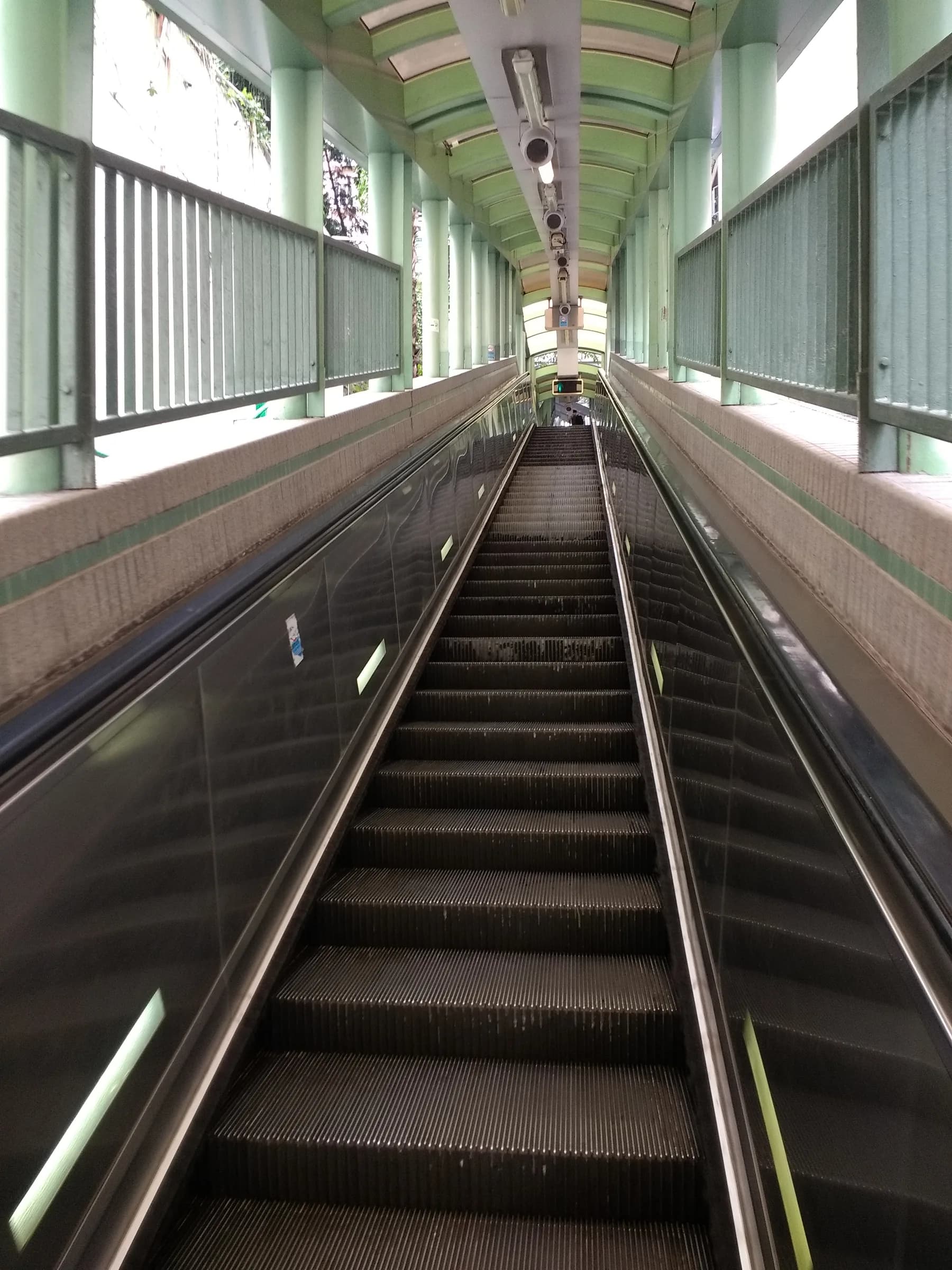
Walking costs nothing and, in the dense, harbour-hugging core of Hong Kong Island and Kowloon, it is frequently the fastest door-to-door option for short hops, not just the cheapest. The city's grid of elevated, covered footbridges and harbourfront promenades means you can cover a surprising amount of ground without touching a road crossing or paying a single dollar of fare. Three corridors do the most work for visitors. Central to Sheung Wan is a short, essentially flat walk of roughly 1.5-2 km (about 20-25 minutes) along Des Voeux Road Central or the parallel Bonham Strand/Wing Lok Street antique and dried-seafood streets, and it beats waiting for a tram or bus for such a short distance. Central to Wan Chai via the Central and Western District waterfront promenade and the elevated Central Elevated Walkway past IFC, the Star Ferry pier, the Central Government Offices and Tamar Park is longer, around 2.5-3 km (30-40 minutes), but it is sheltered from traffic, largely shaded or covered, and arguably the most scenic walking route in the city. Tsim Sha Tsui to Hung Hom along Salisbury Road/Middle Road, or via the Kowloon waterfront, covers about 2 km and is a genuine alternative to a one-stop MTR ride. Hong Kong Island's terraced topography also means some of its most useful pedestrian infrastructure is mechanical: the Central-Mid-Levels Escalator and walkway system covers 800 metres of horizontal distance and climbs more than 135 metres in elevation via 18 escalators and three inclined moving walkways, running downhill only from 6:00 to 10:00 and uphill for the rest of the day until midnight - it is free to use and saves a steep, sweaty climb through the SoHo district. Nearby stepped 'ladder streets' such as Pottinger Street are a reminder that a route that looks flat on a map may in fact be stairs. Walking is worth it for any single leg under about 2 km in the flat waterfront core, for connecting between two nearby transit stops, or when you are already outdoors near your destination; it is not a substitute for crossing the harbour itself, which still requires a ferry, the MTR or a road tunnel. The main real-world pitfall is climate: Hong Kong Observatory's 1991-2020 climate normals put mean relative humidity at 81-82% in June-August against 70-79% in December-February, with mean daily maximum temperatures of 30.7-31.6°C in summer versus 18.7-19.4°C in winter, so a walk that feels trivial in January can be genuinely draining in July and August, especially on the stepped sections. Severe weather is the other constraint: when the Hong Kong Observatory hoists Typhoon Signal No. 8 or above, or a Red or Black Rainstorm Warning, ferries, trams and buses curtail or suspend service well before conditions become dangerous for pedestrians, so an exposed harbourfront or elevated walkway is not automatically a safe fallback in high wind or flooding - the right move in those signals is to shelter, not to walk on. Overnight, some elevated walkways and escalator sections close or reduce hours, and Central's narrow pavements get genuinely congested during the evening rush.
Photos (1)
Comments on "Walking"
Have a take on this ranking?
Comments are how the argument actually happens here. Posting one needs a free account — it takes about a minute.
No comments yet.
The first comment sets the terms of the argument.