Adalaj Stepwell
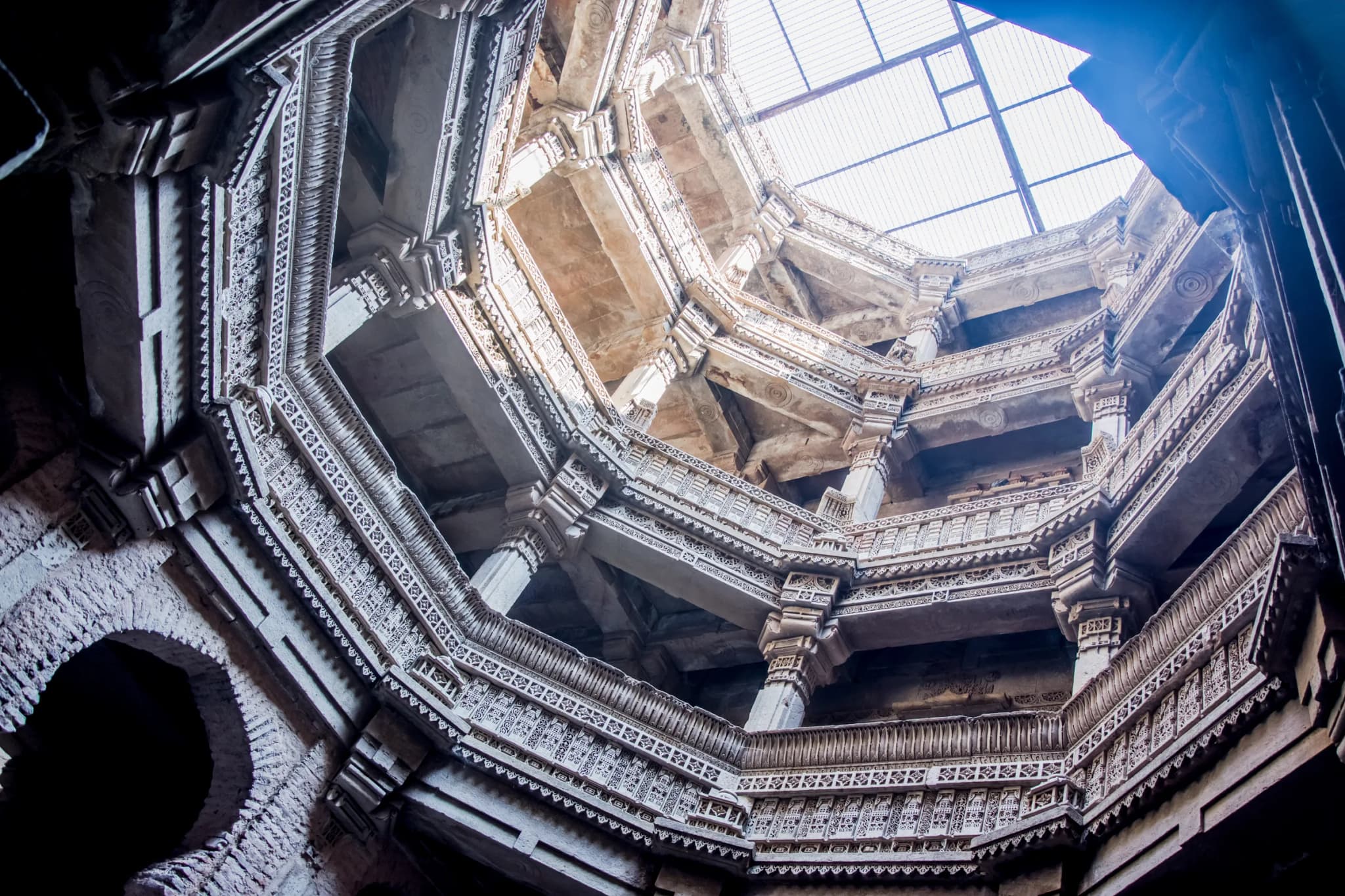
Adalaj Stepwell, in the small town of Adalaj a short drive from Gandhinagar, is unusual among Gujarat's stepwells for the story attached to its construction, which blends a local legend with a documented change of ruler partway through the build. Work is traditionally said to have begun under Rana Veer Singh of the Vaghela dynasty, but after he died before completion, it was finished around 1498-99 under Mahmud Begada, a Muslim sultan, at the request of Veer Singh's widow, Rani Rudabai, known also as Roopba; legend holds that once the well was finished exactly as she had asked, she took her own life by stepping into it. Whatever the truth of that story, the finished structure is a genuine collaboration in stone between two building traditions. Carved in sandstone in the Solanki architectural style, the well descends five storeys through three separate staircases that converge at a central octagonal shaft, open to the sky and ringed by galleries. Its decorative program mixes Hindu and Jain religious imagery, elephants, dancers and musicians, with the floral and geometric patterning associated with Islamic architecture, a pairing found on the same pillars and door frames rather than segregated into separate zones of the building. At the landing level, four small chambers with projecting oriel windows once offered shade and a place to rest for travellers and traders using the well, since Adalaj sat on a trade route rather than serving only the immediate village. Elaborately carved spiral columns surround a funnel-shaped central well floor, using trabeate, or post-and-lintel, construction rather than true arches. Adalaj remains one of the most visited stepwells in Gujarat, an easy half-day trip from Ahmedabad, and one of the best-preserved examples of a stepwell built explicitly to serve travellers rather than a single royal household.
Photos (1)
Comments on "Adalaj Stepwell"
Have a take on this ranking?
Comments are how the argument actually happens here. Posting one needs a free account — it takes about a minute.
No comments yet.
The first comment sets the terms of the argument.