
Photo by Chainwit., CC BY-SA 4.0, via Wikimedia Commons
Top 10 Stepwells of India 2026
Ten of India's finest stepwells, from Rajasthan's inverted-pyramid Chand Baori to the UNESCO-listed Rani ki Vav, with build dates, depths and access notes.
Top10Grid lets the community re-rank anything — this order is our editors' pick for now; use the buttons below to vote it up or down.

Current Rankings
- –
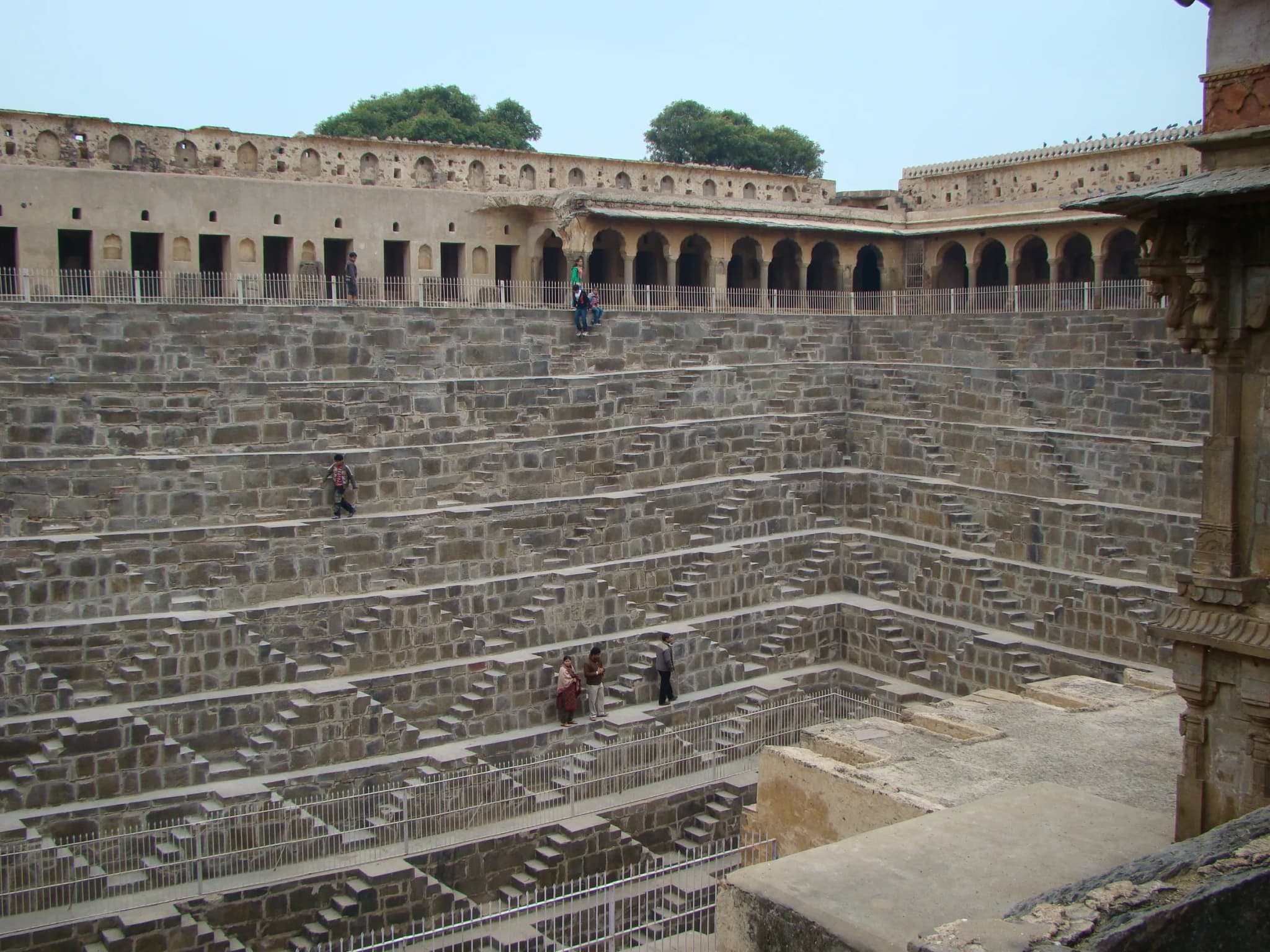
Chand Baori is the stepwell most people picture when they hear the word: an inverted pyramid of steps in the village of Abhaneri, about two and a half hours from Jaipur, that appears to fold in on itself in a dizzying, repeating geometric pattern. It was built between roughly 800 and 900 CE and is named for Raja Chanda of the Nikumbh dynasty, who is credited with commissioning it. Thirteen storeys of steps, some 3,500 of them by the commonly cited count, descend around three sides of a square shaft to a depth of about 30 metres, while the fourth side is given over to a multi-tiered pillared corridor rather than open steps. The point of a structure this large was practical rather than ornamental. Rajasthan's Dausa district sits in a semi-arid stretch of the state where rainfall is concentrated into a short monsoon window, and a stepwell this deep let the surrounding village draw water and, just as importantly, stay cool during the pre-monsoon months, when the deepest tiers held onto both moisture and shade long after the surface had baked dry. Small shrines and carved niches set into the corridor side of the well point to a religious as well as a purely functional role, a combination common to Rajasthani and Gujarati stepwells of the period. Chand Baori has become familiar well beyond Rajasthan through film and photography: it has appeared in several Bollywood productions, including Bhool Bhulaiyaa and Paheli, and its geometric steps are widely reported to have inspired a set built for The Dark Knight Rises, even though that film was not actually shot on location there. The Archaeological Survey of India now protects the site and manages visitor access, and while tourists can walk the corridor side and view the terraced steps from platforms around the rim, the steps themselves are closed off to foot traffic to prevent damage and accidents on the worn stone.
- –
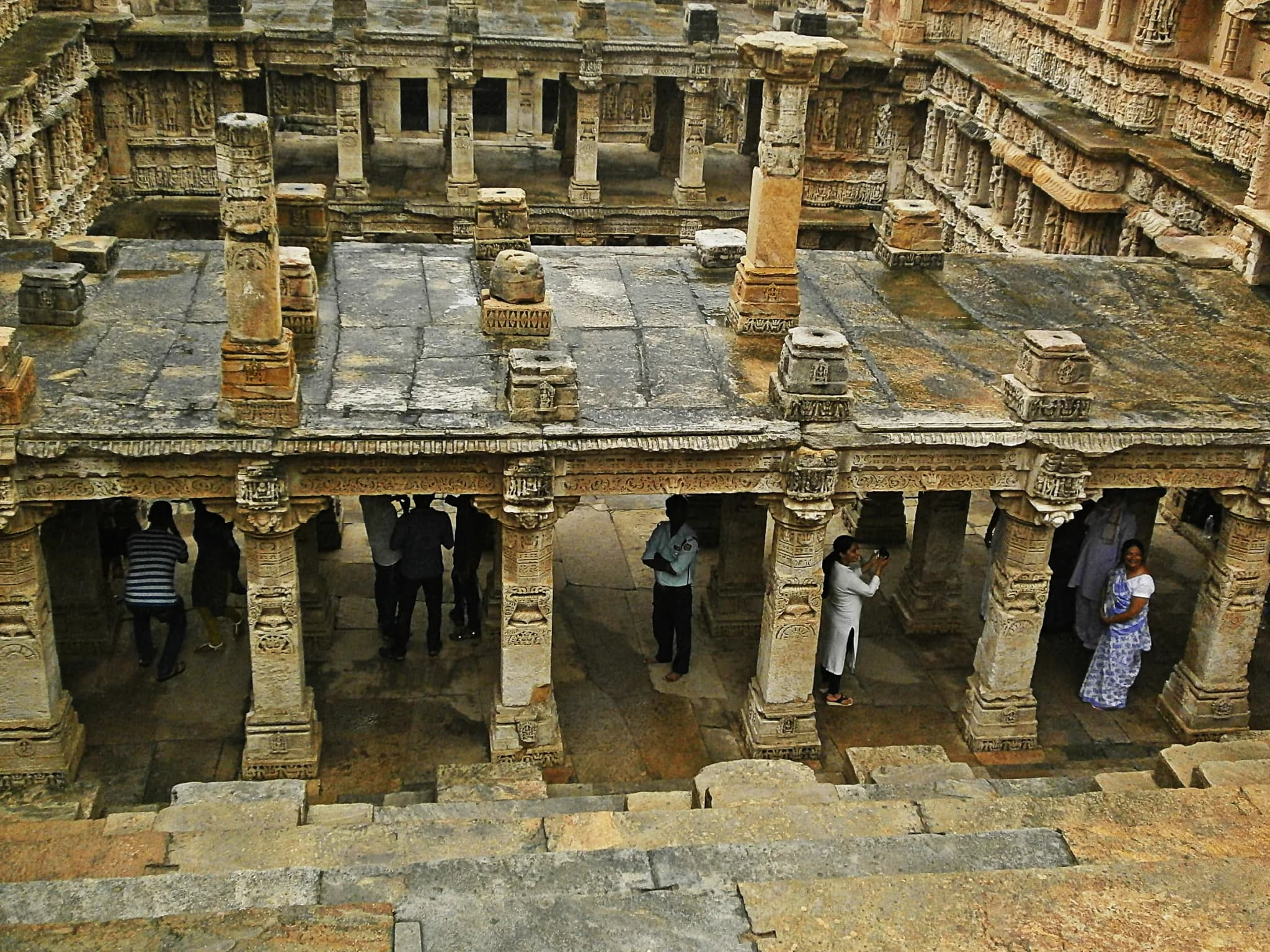
Rani ki Vav, the Queen's Stepwell, is widely regarded as the finest surviving example of the form anywhere in India, and it is the only stepwell on this list inscribed as a UNESCO World Heritage Site, added to the list on 22 June 2014. It stands on the banks of the Saraswati River in Patan, Gujarat, and was commissioned by Queen Udayamati in memory of her husband, King Bhima I of the Chaulukya dynasty, who ruled from around 1022 to 1064. According to the medieval chronicle Prabandha-Chintamani, construction began in 1063 and took twenty years to complete, though some art historians date the well earlier, to around 1032, based on similarities with other Chaulukya-era temples. The scale sets it apart from smaller regional stepwells: the structure runs about 65 metres long, 20 metres wide and 28 metres deep, descending through seven distinct stair levels rather than the four or five typical elsewhere. Every level is carved with sculpture rather than left plain, and researchers count more than 500 principal figures and over a thousand minor ones across the well, depicting Hindu deities, celestial apsaras, and scenes of daily life, making it as much a gallery of 11th-century sculpture as a piece of water infrastructure. The Saraswati River eventually silted the well over completely, burying it for centuries until excavation began in the 1940s; the Archaeological Survey of India carried out a major restoration between 1981 and 1987 that uncovered the sculpture in something close to its original condition. In 2016 it was named India's Cleanest Iconic Place at the Indian Sanitation Conference, and since July 2018 its image has appeared on the reverse of the 100-rupee note, cementing its status as the best-known stepwell in the country.
- –
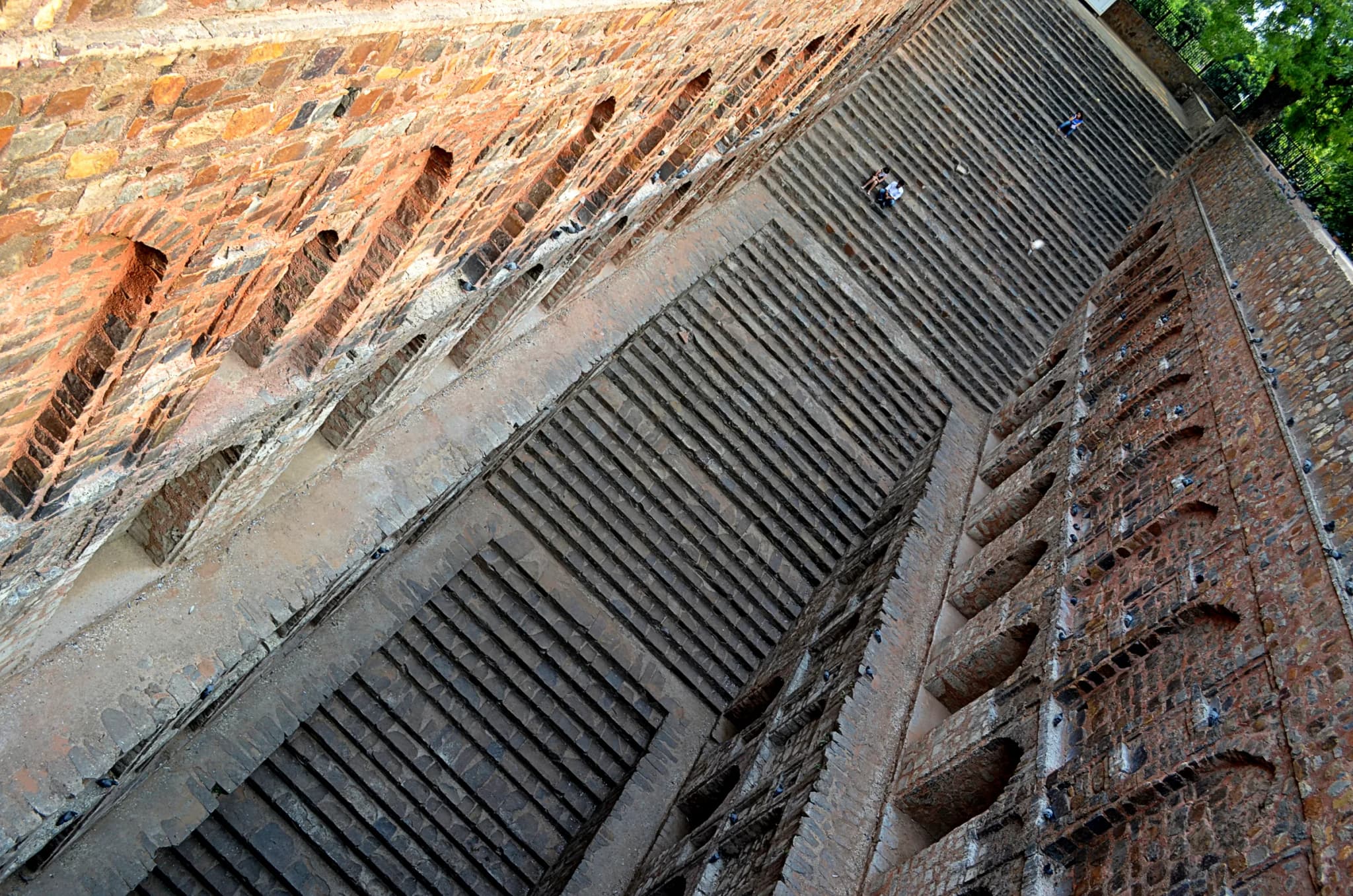
Agrasen ki Baoli sits in the middle of modern New Delhi, a short walk from Connaught Place and Jantar Mantar, which makes it the most accessible stepwell in this list for anyone without a long journey to Rajasthan or Gujarat. The 60-metre-long, 15-metre-wide well descends through 108 steps across three visible levels, each lined on both sides with arched niches that once would have held small rooms or shaded rest areas for people waiting to draw water. Nobody knows for certain who built it. Local tradition credits the legendary king Agrasen, ancestor of the Aggarwal trading community, with an original construction long before Delhi's Sultanate period, and members of the Aggarwal community are believed to have rebuilt the well in his honour; the structure's actual stonework, though, points architecturally to the Tughlaq or Lodi period of the Delhi Sultanate, several centuries later than the legend implies. Its formal listing name with the Archaeological Survey of India, which protects it as monument N-DL-52 under the Ancient Monuments and Archaeological Sites and Remains Act of 1958, is Ugrasen ki Baoli. The well's dramatic, symmetrical descent has made it one of Bollywood's favourite ready-made film sets, appearing in productions including PK, Sultan and Mom, and it was also featured as a challenge location on The Amazing Race Australia. Alongside that cinematic reputation runs a persistent local legend that the baoli is haunted, tied to stories about the dark, still water once said to fill its lowest levels; the water has long since dried up, and today the well is dry from top to bottom. It is open to the public daily from 9am to 5:30pm and remains free to visit, a rare central Delhi heritage site that most tourists still walk past without noticing.
- –
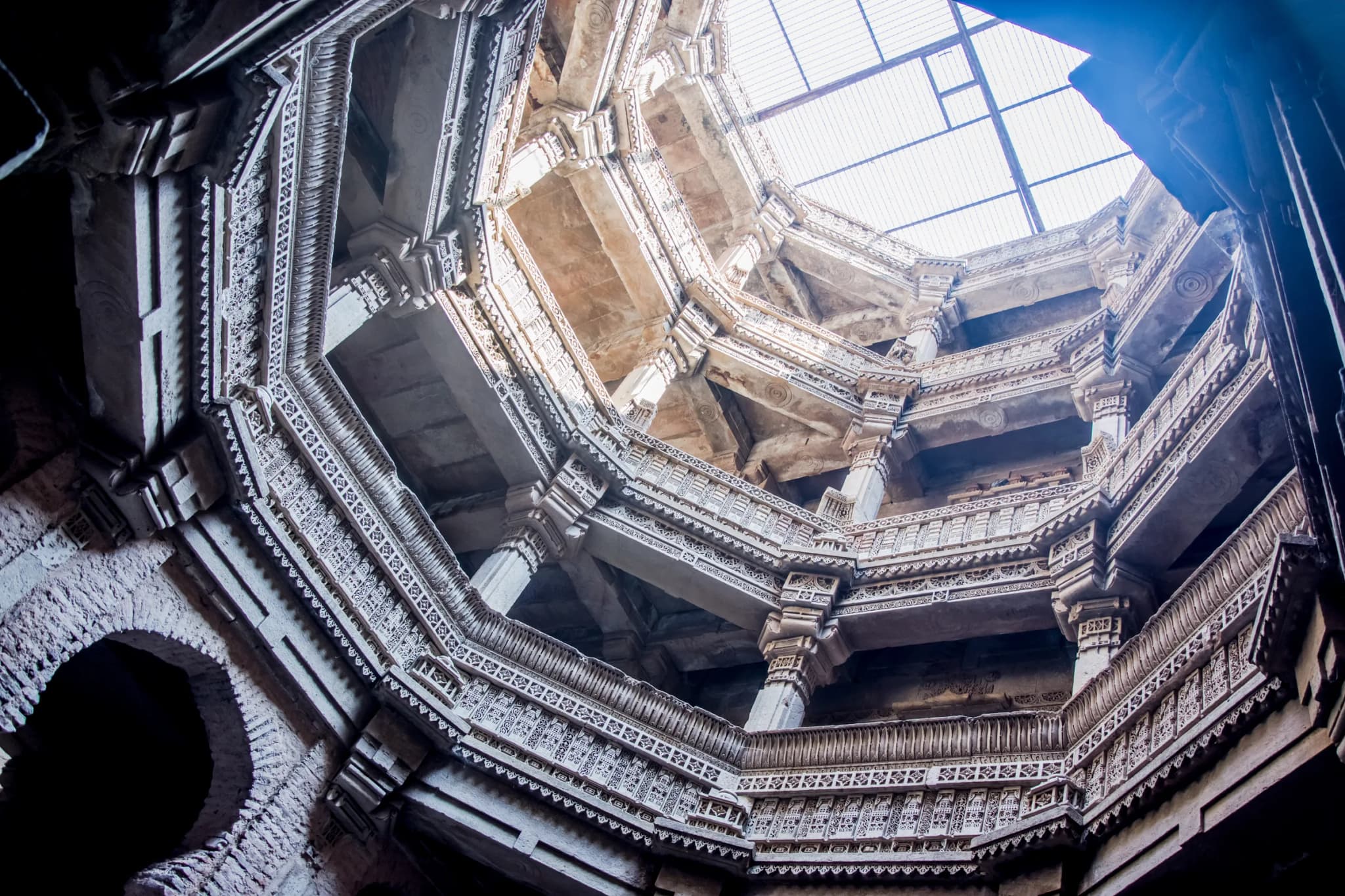
Adalaj Stepwell, in the small town of Adalaj a short drive from Gandhinagar, is unusual among Gujarat's stepwells for the story attached to its construction, which blends a local legend with a documented change of ruler partway through the build. Work is traditionally said to have begun under Rana Veer Singh of the Vaghela dynasty, but after he died before completion, it was finished around 1498-99 under Mahmud Begada, a Muslim sultan, at the request of Veer Singh's widow, Rani Rudabai, known also as Roopba; legend holds that once the well was finished exactly as she had asked, she took her own life by stepping into it. Whatever the truth of that story, the finished structure is a genuine collaboration in stone between two building traditions. Carved in sandstone in the Solanki architectural style, the well descends five storeys through three separate staircases that converge at a central octagonal shaft, open to the sky and ringed by galleries. Its decorative program mixes Hindu and Jain religious imagery, elephants, dancers and musicians, with the floral and geometric patterning associated with Islamic architecture, a pairing found on the same pillars and door frames rather than segregated into separate zones of the building. At the landing level, four small chambers with projecting oriel windows once offered shade and a place to rest for travellers and traders using the well, since Adalaj sat on a trade route rather than serving only the immediate village. Elaborately carved spiral columns surround a funnel-shaped central well floor, using trabeate, or post-and-lintel, construction rather than true arches. Adalaj remains one of the most visited stepwells in Gujarat, an easy half-day trip from Ahmedabad, and one of the best-preserved examples of a stepwell built explicitly to serve travellers rather than a single royal household.
- –
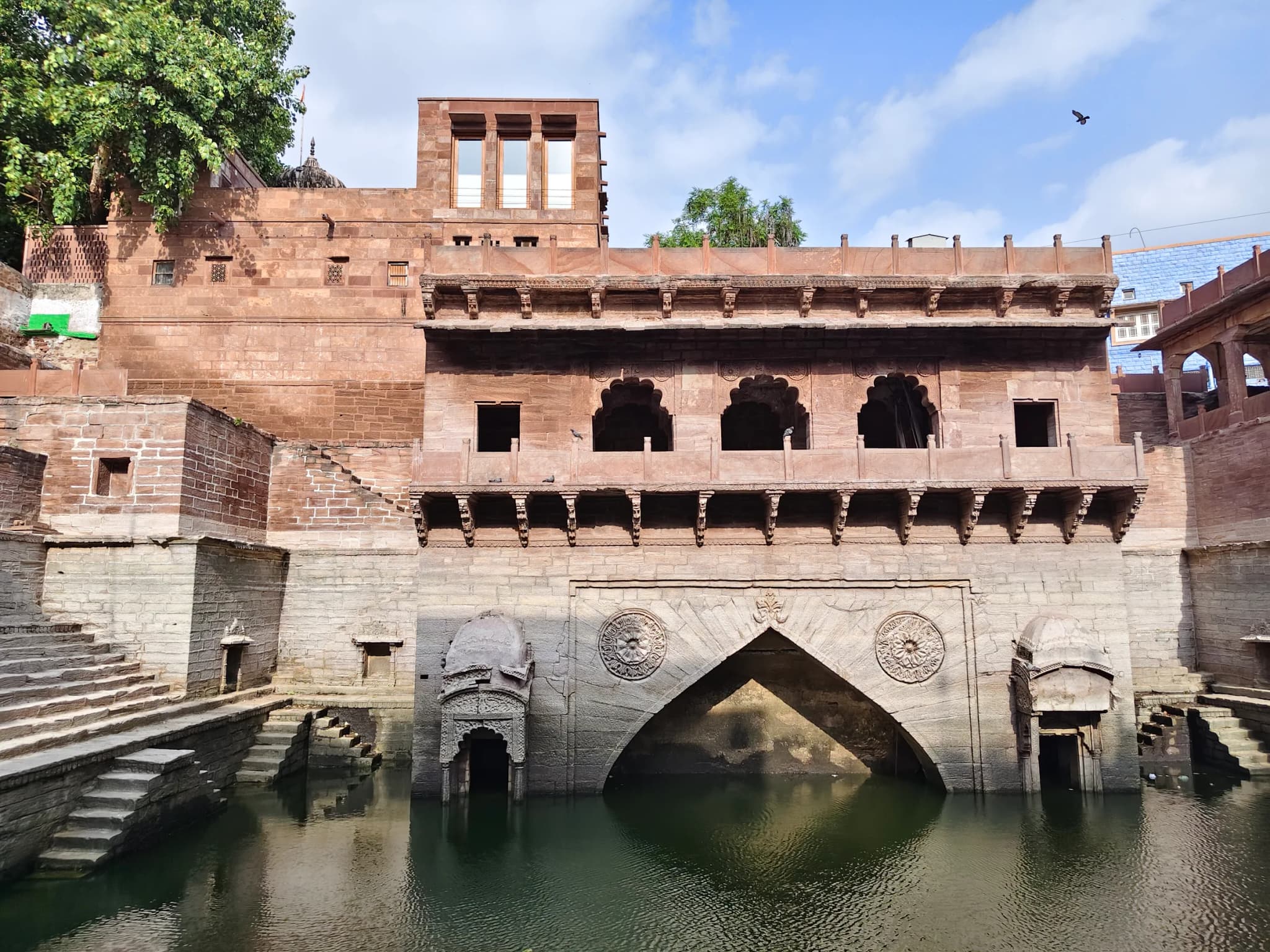
Toorji Ka Jhalra sits tucked among the narrow lanes of Jodhpur's old city, close enough to Mehrangarh Fort, about 300 metres away, that many visitors to the fort walk straight past it without realising it is there. The well's construction date is disputed: some accounts point to origins as early as the 6th century, but the structure standing today is generally dated to 1740, and is traditionally attributed to Maharani Tanwarji, wife of Maharaja Abhai Singh of Jodhpur, although no contemporary document confirms her patronage directly. What is not in dispute is the material and craftsmanship: the well is carved from the same red sandstone used across Jodhpur's old city and Mehrangarh Fort itself, cut into deep tiers of steps in the ornamented Rajasthani style typical of Marwar-region stepwells, with carved niches set into the surrounding walls. Unlike some of the larger Rajasthani stepwells built to guarantee a year-round water supply, Toorji Ka Jhalra fills mainly during the monsoon months of June to September and is often dry, or close to it, by the following spring, making the timing of a visit matter for anyone hoping to see it holding water rather than bare stone. The well's local prominence was formally recognised in 2017, when India Post issued a commemorative postage stamp featuring Toorji Ka Jhalra as part of a series on the country's historic stepwells. Despite that recognition, it remains relatively unfamiliar even to many residents of Jodhpur, a contrast with Mehrangarh Fort's fame just a few hundred metres away. Reaching it means navigating the same tangle of narrow, blue-painted lanes that make Jodhpur's old city a destination in its own right, with the well itself serving as a quiet, shaded break from that walk.
- –
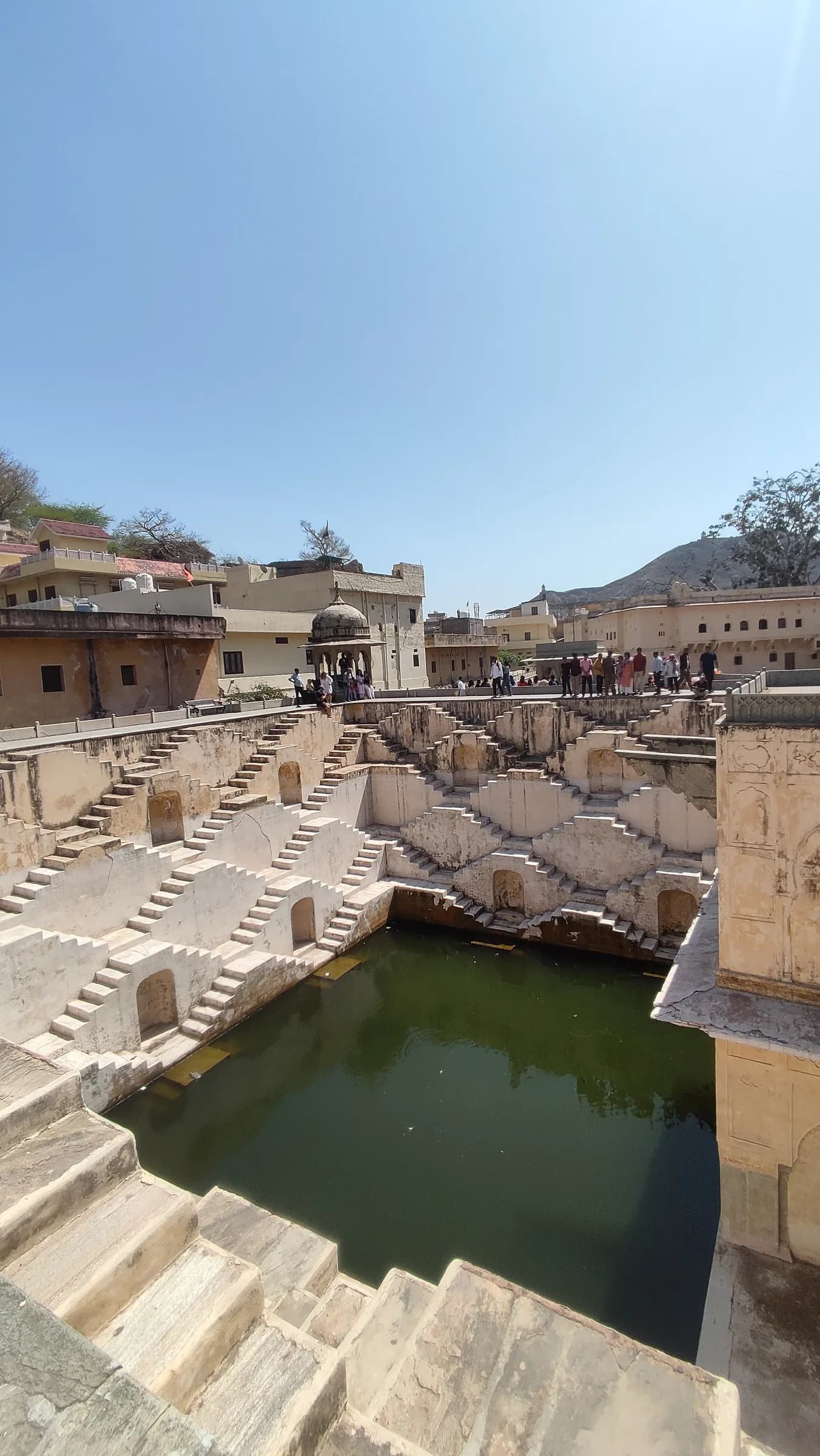
Panna Meena ka Kund sits in the town of Amber, in the shadow of Amer Fort on the outskirts of Jaipur, and it draws more photographers than perhaps any other stepwell in Rajasthan for one simple reason: it is built with a near-perfect fourfold symmetry, with staircases descending on all four sides of the square shaft in a zigzag pattern that meets at a small central platform above the water. Seen from above or through a wide-angle lens, the crossing staircases create an optical, almost kaleidoscopic pattern that has made the well a fixture of photography from Rajasthan. Unlike Chand Baori or Rani ki Vav, Panna Meena ka Kund has no single, well-documented origin story. It is sometimes described as a tenth-century structure, though, like a number of monuments in and around Amber, no inscription or chronicle confirms an exact construction date. What is well documented is its setting: it lies a short walk from Amer Fort, the Jaipur region's most-visited hilltop fort and palace complex, and from Jaigarh Fort above it, making it an easy add-on stop for visitors already spending a day in Amber rather than a standalone destination. Its striking geometry has also made it a recurring film and television location. It appears in The Best Exotic Marigold Hotel, in a scene built around the stepwell's setting, and has featured as a checkpoint on international editions of the reality competition The Amazing Race, including The Amazing Race 35 and the Norwegian version of the show. Visitors can walk partway down the staircases on most sides, though the lowest steps closest to the water are usually roped off, both to protect the stonework and because the steps become slippery and uneven near the base.
- –
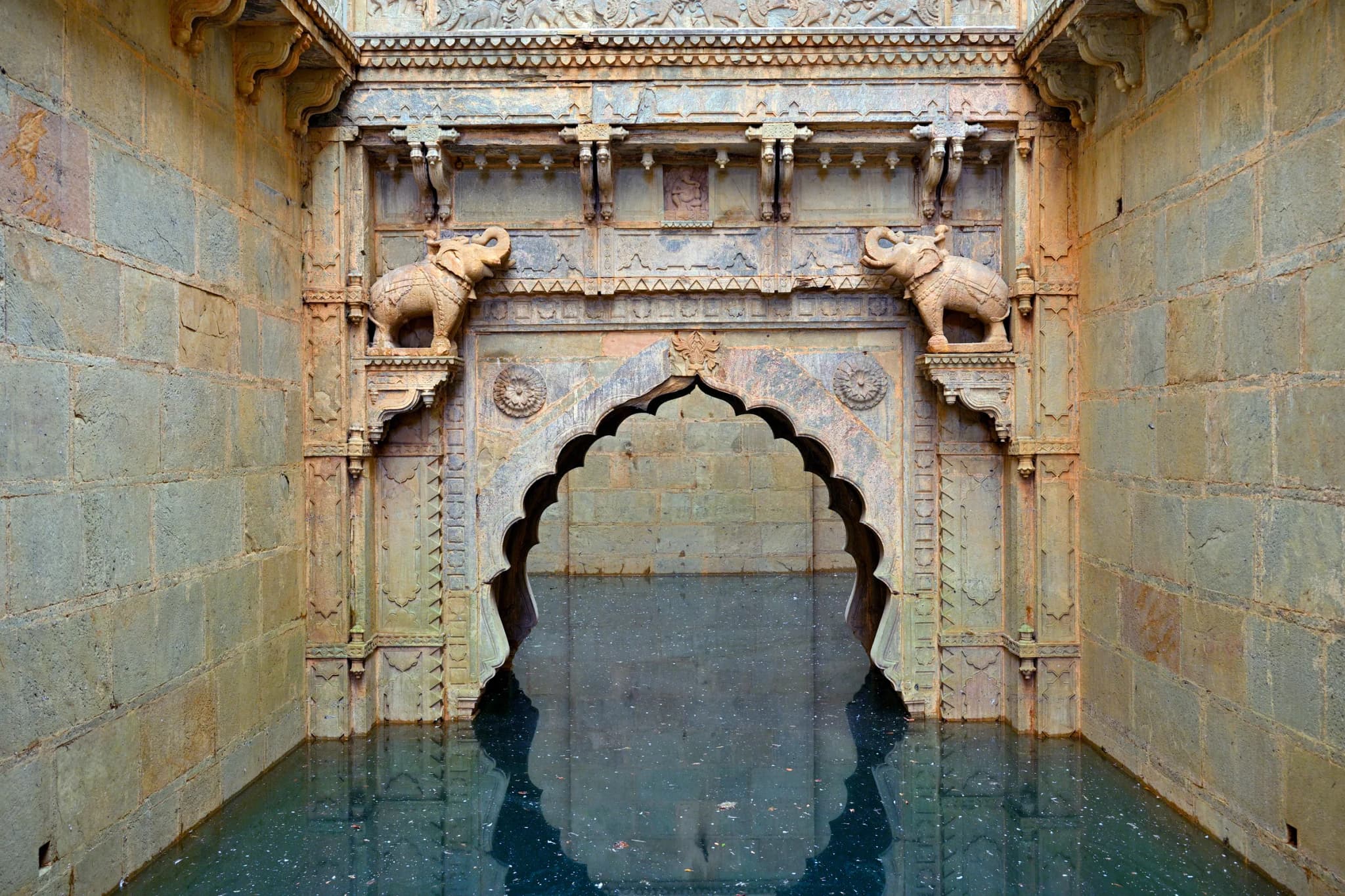
Raniji ki Baori, the Queen's Stepwell, is the best known of more than sixty baolis scattered through the town of Bundi in Rajasthan, a concentration of stepwells unmatched almost anywhere else in the state. It was built in 1699 by Rani Nathavati Solanki, queen of Raja Anirudh Singh of Bundi, during the reign of her son, Maharao Raja Budh Singh, who ruled from 1695 to 1729, making it a rare stepwell commissioned by a queen mother rather than a reigning king. The well descends 46 metres, a genuinely deep shaft by regional standards, through a multistorey structure that includes small shrines and places of worship set into each level rather than confining religious use to a single ground-floor niche. Its entrance is marked by a high, ornately arched gateway flanked by four carved pillars, each corner guarded by a carved stone elephant, a common motif on Rajasthani royal architecture signalling status and protection. Ogee-shaped brackets, curved supports that flare outward before meeting the arch above them, decorate the archways throughout the structure, a detailing style shared with several other Bundi-era buildings from the same period. Directly across from Raniji ki Baori stands Nagar Sagar Kund, a pair of twin stepwells built in a similar style, and together with dozens of smaller baolis throughout the old town, they make Bundi arguably the best place in India to see stepwell architecture in density rather than as a single isolated monument. Bundi's stepwells receive far fewer visitors than Chand Baori or the stepwells around Jaipur and Ahmedabad, despite comparable scale and craftsmanship, largely because the town sits off the main Rajasthan tourist circuit between Kota and Chittorgarh.
- –
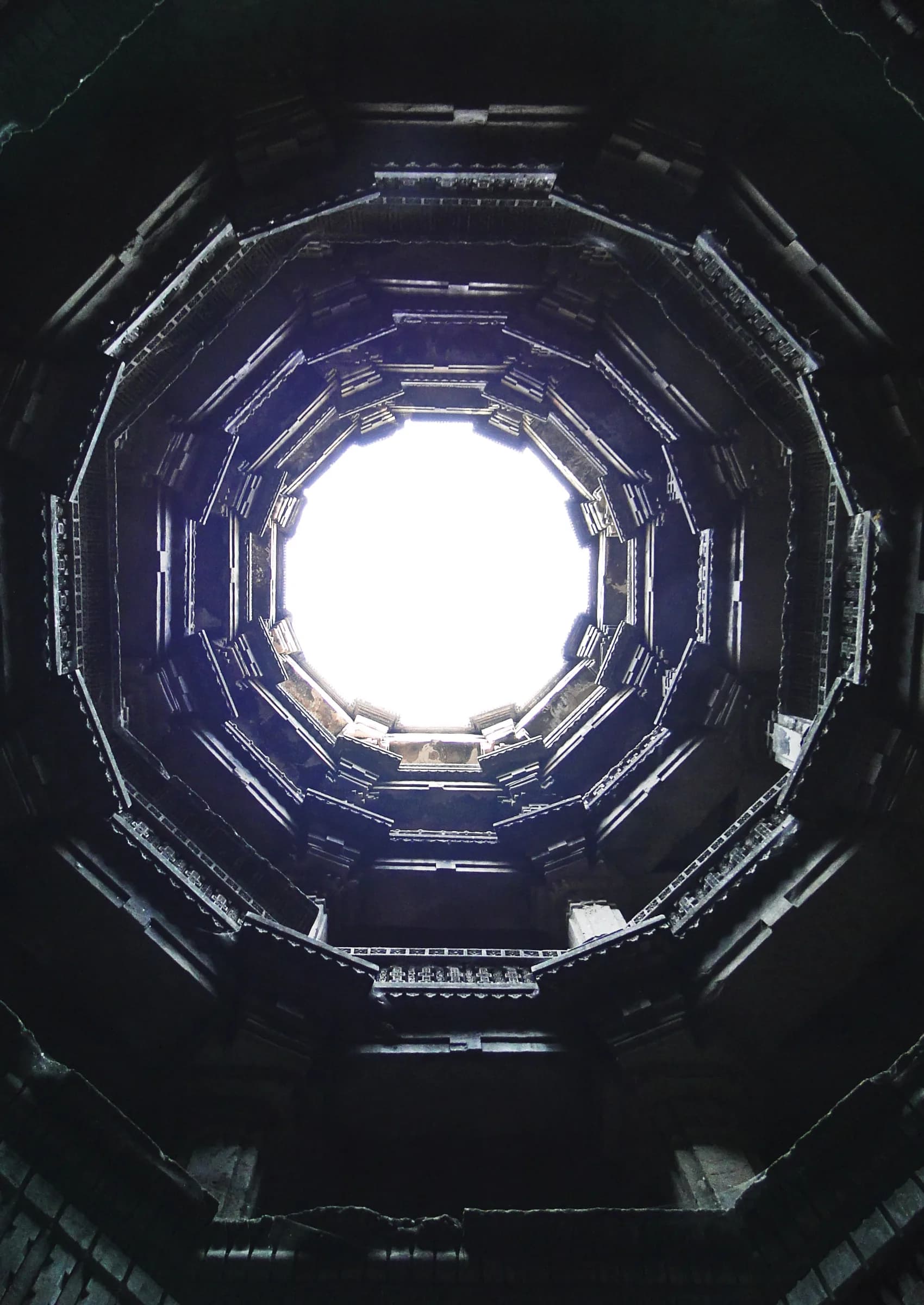
Dada Harir Stepwell, tucked into the Asarwa neighbourhood about 15 kilometres from the centre of Ahmedabad, was commissioned in 1485 by Dhai Harir, also recorded as Bai Harir Sultani, a woman who served as superintendent of the royal harem under Sultan Mahmud Begada. That makes it, like Adalaj not far away, one of a small number of major Gujarati stepwells built under the patronage of a woman rather than a male ruler. A Sanskrit inscription found at the site gives a slightly later date, December 1499, and historians treat the gap between the two dates as an open question rather than a settled fact, possibly reflecting a later addition or rededication rather than an error in either source. The well descends five storeys, following the same general depth as Adalaj and its other Solanki-era contemporaries, built in sandstone and following the same regional style: carved pillars, geometric patterning, and, at the well's eastern level, an octagonal plan open to the sky. Its decorative vocabulary again mixes traditions, combining floral and geometric motifs associated with Islamic design with the sculpted figural and ornamental work more typical of earlier Hindu and Jain temple carving, a blend that runs through most Gujarati stepwells built during the Sultanate period. The Archaeological Survey of India lists Dada Harir Stepwell as a Monument of National Importance under reference N-GJ-18, and it remains open to visitors, ranked among Ahmedabad's more visited historical attractions even though it sits well outside the old walled city that draws most tourists to Ahmedabad's heritage sites. Its relative quiet compared with better-known Gujarati stepwells makes it one of the easier places on this list to see carved stepwell architecture without a crowd.
- –
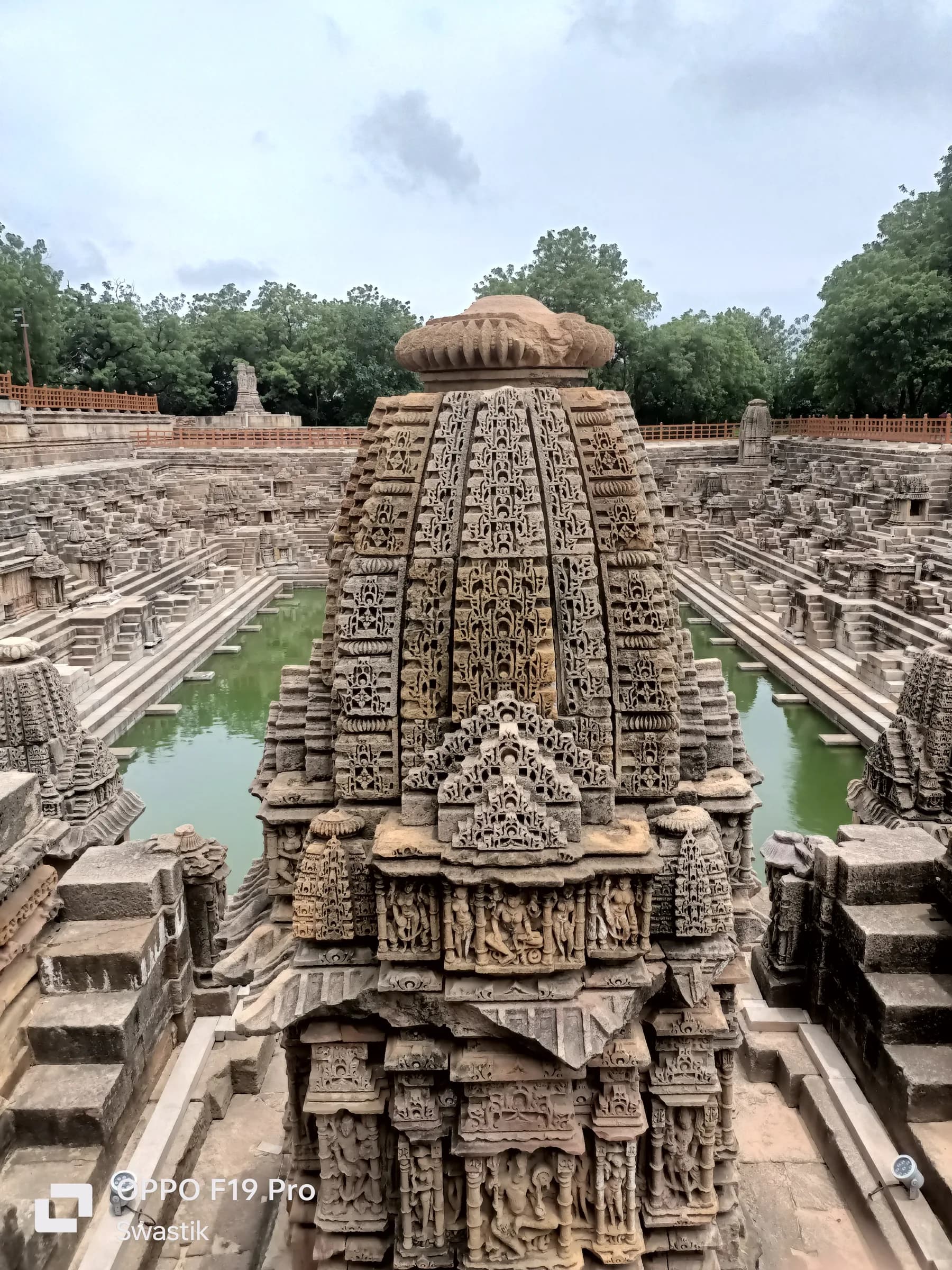
The Surya Kund at Modhera is not a stand-alone stepwell but the great stepped tank built in front of the Sun Temple at Modhera, in Gujarat's Mehsana district, and by measured area it is among the largest structures of its kind attached to any Indian temple. The tank was built slightly earlier than the temple's main shrine, which was completed shortly after 1026 CE under King Bhima I of the Chaulukya dynasty, in the years following Mahmud of Ghazni's invasion of Gujarat; the kund itself is dated to the very start of the 11th century, making it a rare case of the water tank predating the sanctuary it eventually stood beside. The tank measures 176 feet from north to south and 120 feet from east to west, descending through four terraces connected by recessed flights of steps, with the main entrance approach on the western side and further stairways crossing between terraces at right angles to each other. A distinctive design detail runs through every flight: the steps themselves are cut rectangular or square, except for the first step of each flight, which is carved semicircular, a small but consistent architectural signature across the whole tank. Set into the terrace walls around the tank are numerous miniature shrines and carved niches, housing images of Vaishnavite deities, including the goddess Shitala among others, effectively turning the walk down to the water into a devotional circuit rather than a purely functional descent. Because the Surya Kund forms the ceremonial forecourt to one of Gujarat's most important surviving Sun Temples, it is rarely visited in isolation; almost everyone who sees it does so as part of a visit to the temple complex as a whole, reached by road from Mehsana or as a day trip from Ahmedabad.
- –
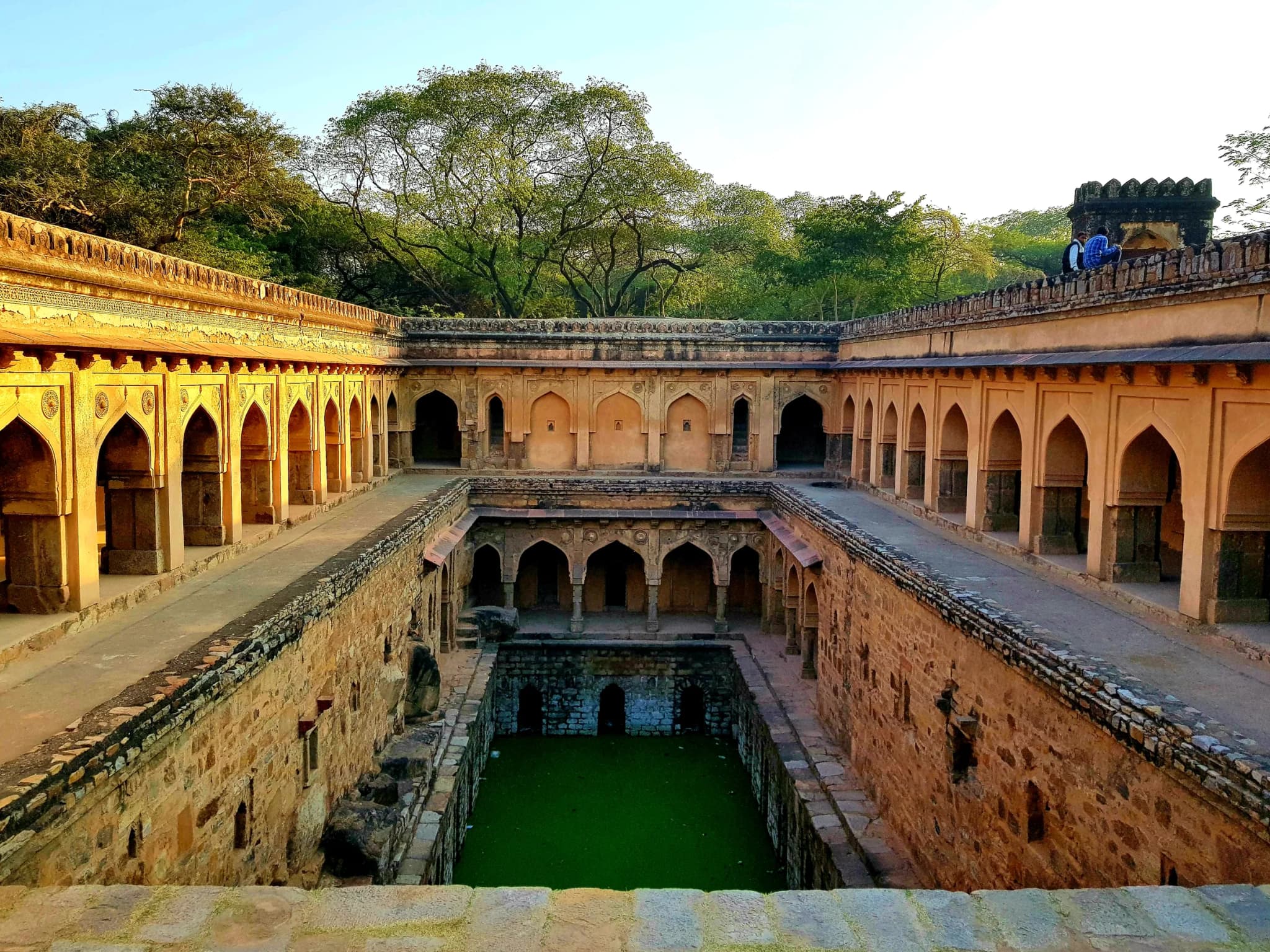
Rajon ki Baoli stands inside the Mehrauli Archaeological Park in South Delhi, a short walk from Adham Khan's Tomb and another stepwell, Gandhak ki Baoli, in one of the densest concentrations of medieval monuments anywhere in the capital. It was commissioned in 1506 CE by Daulat Khan Lodi, an administrator under the Lodi dynasty, toward the end of the Delhi Sultanate period, and is generally considered one of the best-preserved stepwells from that era anywhere in Delhi. The name Rajon ki Baoli comes not from royalty but from labour: it derives from Rajbirs, or Mistris, the historical term for stonemasons, suggesting the well may have served or been associated with the city's masons' community rather than a single ruling family. Steps descend from the northern side of the well down to the water, while high walls run along the eastern and western sides, each set with twelve pillars framing arched niches in the Indo-Islamic style typical of late Sultanate-period Delhi. A columned verandah surrounds part of the courtyard above, giving the whole complex the feel of a small enclosed compound rather than an open pit. Unusually for a stepwell, the surrounding enclosure also includes a mosque and a tomb, built as part of the same complex rather than added later, which underlines how thoroughly stepwells in Delhi's Sultanate period doubled as religious and memorial architecture alongside their practical role supplying water. The Archaeological Survey of India lists Rajon ki Baoli as a Monument of National Importance and carried out a restoration of the site completed in 2025. Because it sits inside Mehrauli Archaeological Park rather than a fenced single-monument site, it is usually visited alongside the park's dozen-plus other medieval structures rather than as a solo destination.
| Item | Built | Style | Location | Access today | Depth / levels |
|---|---|---|---|---|---|
| #1Chand Baori | c. 800–900 CE, attributed to Raja Chanda of the Nikumbh dynasty | Inverted-pyramid steps on three sides, pillared corridor on the fourth | Abhaneri, Dausa district, Rajasthan | ASI-protected; viewing from rim platforms, steps closed to foot traffic | About 30 m deep, 13 storeys, roughly 3,500 steps |
| #2Rani ki Vav | 11th century, commissioned by Queen Udayamati for King Bhima I; construction begun 1063 per the Prabandha-Chintamani | Maru-Gurjara sculpted stepwell with over 500 major and 1,000 minor carved figures | Patan, Gujarat, on the Saraswati River | UNESCO World Heritage Site since 2014; restored by the ASI 1981–87 | 65 m long, 20 m wide, 28 m deep, across 7 stair levels |
| #3Agrasen ki Baoli | Builder unknown; stonework points to the Tughlaq or Lodi period of the Delhi Sultanate | Arched niches lining both sides of the descent | Hailey Road, New Delhi, near Connaught Place | ASI-protected (N-DL-52); open daily 9am–5:30pm, free entry | 60 m long, 15 m wide, 108 steps across 3 visible levels |
| #4Adalaj Stepwell | 1498–99, begun under Rana Veer Singh (Vaghela dynasty), completed under Sultan Mahmud Begada | Solanki-style sandstone carving blending Hindu, Jain and Islamic motifs | Adalaj, near Gandhinagar, Gujarat | Open to visitors; a common half-day trip from Ahmedabad | 5 storeys deep, 3 staircases converging on a central octagonal shaft |
| #5Toorji Ka Jhalra | Generally dated to 1740, traditionally attributed to Maharani Tanwarji | Carved Marwar-region red sandstone, matching Mehrangarh Fort's stone | Jodhpur old city, Rajasthan, near Mehrangarh Fort | Open in Jodhpur's old city; featured on a 2017 Indian postage stamp | Deep tiered red-sandstone steps; fills mainly June–September |
| #6Panna Meena ka Kund | Undated; sometimes described as 10th century, unconfirmed by inscription | Fourfold symmetric geometric stepwell | Amber, near Amer Fort, Jaipur district, Rajasthan | Open near Amer Fort; lowest steps near the water roped off | Symmetrical zigzag staircases on all 4 sides meeting at a central platform |
| #7Raniji ki Baori | 1699, by Rani Nathavati Solanki, during the reign of Maharao Raja Budh Singh | Carved pillars, elephant-guarded corners, ogee-bracketed archways | Bundi, Rajasthan | Open in Bundi's old town, alongside Nagar Sagar Kund and 60+ other baolis | 46 m deep, multistorey with shrines set into each level |
| #8Dada Harir Stepwell | 1485 (a Sanskrit inscription gives December 1499), commissioned by Dhai Harir under Mahmud Begada | Solanki-style sandstone carving mixing Hindu, Jain and Islamic motifs | Asarwa, Ahmedabad, Gujarat | ASI Monument of National Importance (N-GJ-18), open to visitors | 5 storeys deep, octagonal plan at the eastern level |
| #9Surya Kund, Modhera Sun Temple | Early 11th century, predating the main shrine completed shortly after 1026 CE under Bhima I | Stepped temple tank with miniature Vaishnavite shrines set into the terrace walls | Modhera, Mehsana district, Gujarat | Visited as part of the Modhera Sun Temple complex | 176 ft (N–S) by 120 ft (E–W), 4 terraces with recessed steps |
| #10Rajon ki Baoli | 1506 CE, commissioned by Daulat Khan Lodi under the Delhi Sultanate | Indo-Islamic Lodi-period stepwell with an attached mosque and tomb | Mehrauli Archaeological Park, South Delhi | ASI Monument of National Importance, restored 2025, part of Mehrauli Archaeological Park | North-side steps; east and west walls each set with 12 pillared niches |
Image credits
- Chand Baori: Photo by Arpita Roy08, CC BY-SA 3.0, via Wikimedia Commons
- Rani ki Vav: Photo by Vistarphotos, CC BY-SA 4.0, via Wikimedia Commons
- Agrasen ki Baoli: Photo by Pankaj Purohit, CC BY-SA 4.0, via Wikimedia Commons
- Adalaj Stepwell: Photo by Vipulvaibhav5, CC BY-SA 4.0, via Wikimedia Commons
- Toorji Ka Jhalra: Photo by Ramesh Deuba, CC BY-SA 3.0, via Wikimedia Commons
- Panna Meena ka Kund: CC0 (public domain), via Wikimedia Commons
- Raniji ki Baori: Photo by Sharvarism, CC BY-SA 4.0, via Wikimedia Commons
- Dada Harir Stepwell: Photo by Ronakshah1990, CC BY-SA 4.0, via Wikimedia Commons
- Surya Kund, Modhera Sun Temple: CC0 (public domain), via Wikimedia Commons
- Rajon ki Baoli: Photo by Rupeshsarkar, CC BY-SA 4.0, via Wikimedia Commons
Rank it your way
Remix this list into your own ranking, or head to the play hub for every game mode and community breakdown — blind mode, challenges, tier lists, and more.
You Might Also Like
Top 10 Must-Visit Destinations in Germany
Top 10 Must-Visit Destinations in Germany
10 Most Beautiful Cities in Spain to Visit in 2024: A Traveler's Guide
10 Most Beautiful Cities in Spain to Visit in 2024: A Tra...

Top 10 Luxury Wellness Retreats to Book in 2026
Top 10 Luxury Wellness Retreats to Book in 2026
Top 10 Brazilian Beaches
#1 Baia do Sancho, Fernando de Noronha · #2 Praia do Espelho, Bahia · #3 Praia de Jericoacoara, Ceara
Top 10 Best Backpacking Routes in the World
#1 Southeast Asia Overland (Thailand to Vietnam) · #2 Inca Trail, Peru · #3 Trans-Siberian Railway, Russia

Top 10 Best Islands for a Tropical Getaway
#1 Bali, Indonesia · #2 Maldives · #3 Bora Bora, French Polynesia