Chand Baori
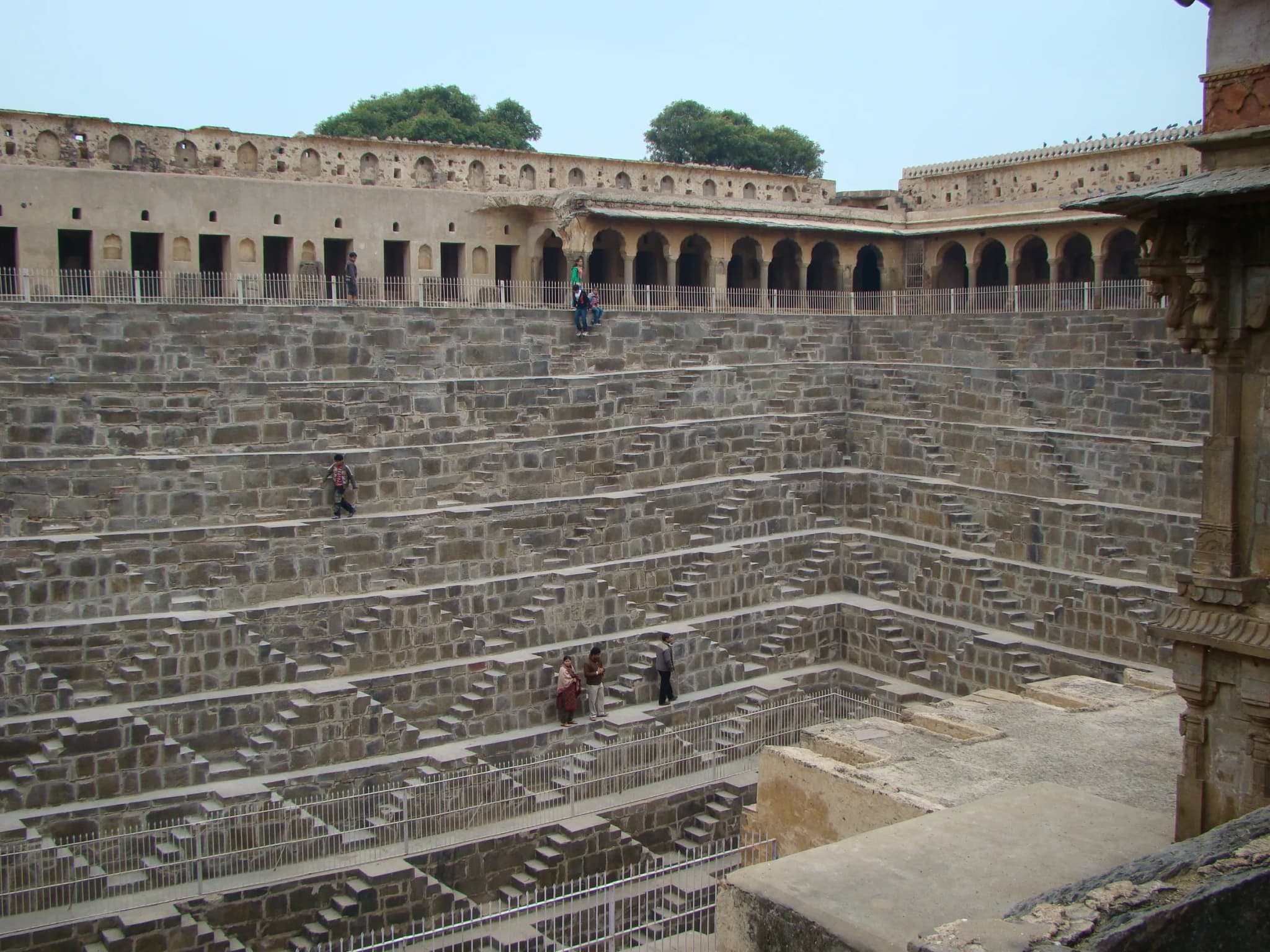
Chand Baori is the stepwell most people picture when they hear the word: an inverted pyramid of steps in the village of Abhaneri, about two and a half hours from Jaipur, that appears to fold in on itself in a dizzying, repeating geometric pattern. It was built between roughly 800 and 900 CE and is named for Raja Chanda of the Nikumbh dynasty, who is credited with commissioning it. Thirteen storeys of steps, some 3,500 of them by the commonly cited count, descend around three sides of a square shaft to a depth of about 30 metres, while the fourth side is given over to a multi-tiered pillared corridor rather than open steps. The point of a structure this large was practical rather than ornamental. Rajasthan's Dausa district sits in a semi-arid stretch of the state where rainfall is concentrated into a short monsoon window, and a stepwell this deep let the surrounding village draw water and, just as importantly, stay cool during the pre-monsoon months, when the deepest tiers held onto both moisture and shade long after the surface had baked dry. Small shrines and carved niches set into the corridor side of the well point to a religious as well as a purely functional role, a combination common to Rajasthani and Gujarati stepwells of the period. Chand Baori has become familiar well beyond Rajasthan through film and photography: it has appeared in several Bollywood productions, including Bhool Bhulaiyaa and Paheli, and its geometric steps are widely reported to have inspired a set built for The Dark Knight Rises, even though that film was not actually shot on location there. The Archaeological Survey of India now protects the site and manages visitor access, and while tourists can walk the corridor side and view the terraced steps from platforms around the rim, the steps themselves are closed off to foot traffic to prevent damage and accidents on the worn stone.
Photos (1)
Comments on "Chand Baori"
Have a take on this ranking?
Comments are how the argument actually happens here. Posting one needs a free account — it takes about a minute.
No comments yet.
The first comment sets the terms of the argument.