Raniji ki Baori
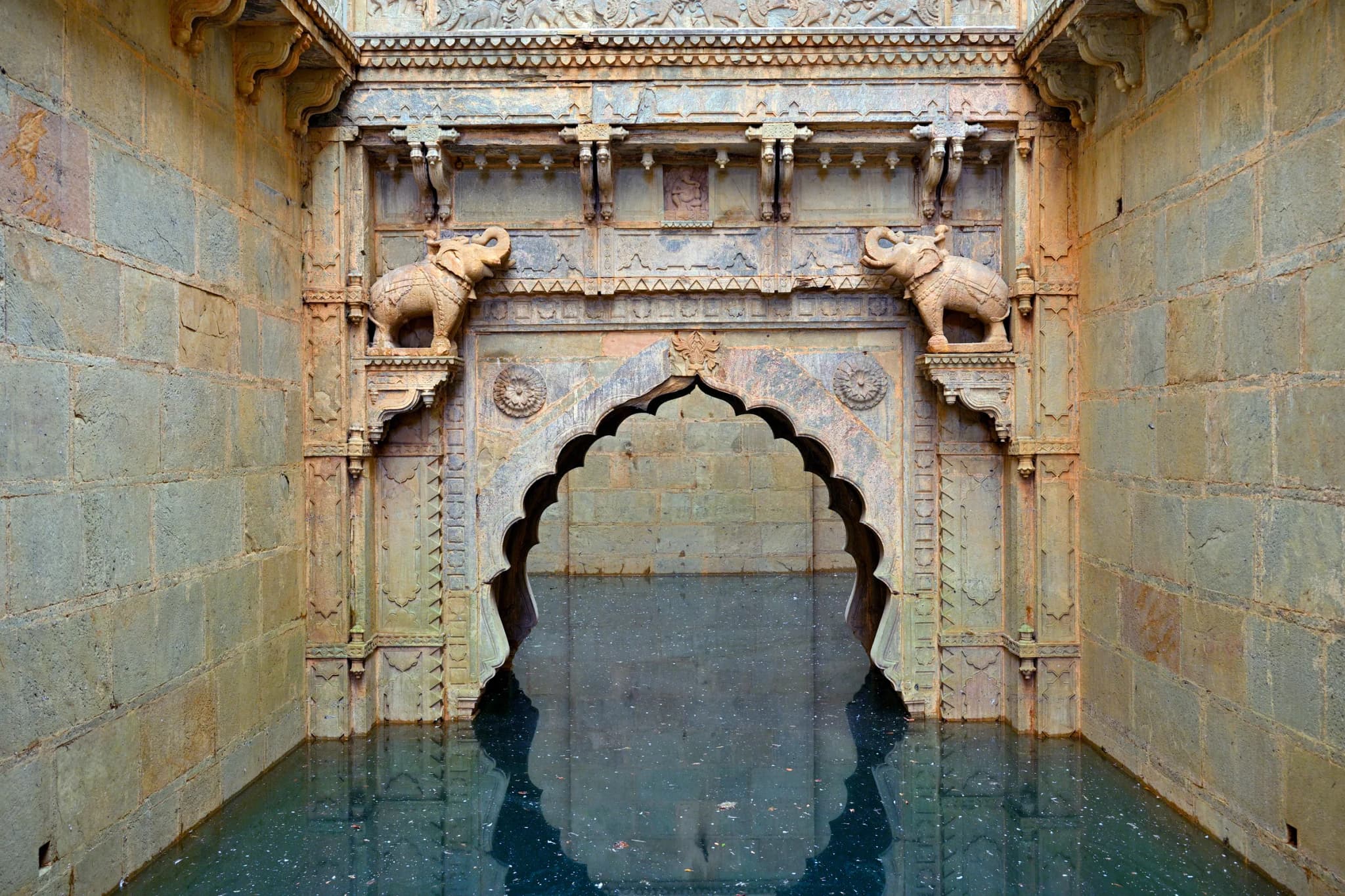
Raniji ki Baori, the Queen's Stepwell, is the best known of more than sixty baolis scattered through the town of Bundi in Rajasthan, a concentration of stepwells unmatched almost anywhere else in the state. It was built in 1699 by Rani Nathavati Solanki, queen of Raja Anirudh Singh of Bundi, during the reign of her son, Maharao Raja Budh Singh, who ruled from 1695 to 1729, making it a rare stepwell commissioned by a queen mother rather than a reigning king. The well descends 46 metres, a genuinely deep shaft by regional standards, through a multistorey structure that includes small shrines and places of worship set into each level rather than confining religious use to a single ground-floor niche. Its entrance is marked by a high, ornately arched gateway flanked by four carved pillars, each corner guarded by a carved stone elephant, a common motif on Rajasthani royal architecture signalling status and protection. Ogee-shaped brackets, curved supports that flare outward before meeting the arch above them, decorate the archways throughout the structure, a detailing style shared with several other Bundi-era buildings from the same period. Directly across from Raniji ki Baori stands Nagar Sagar Kund, a pair of twin stepwells built in a similar style, and together with dozens of smaller baolis throughout the old town, they make Bundi arguably the best place in India to see stepwell architecture in density rather than as a single isolated monument. Bundi's stepwells receive far fewer visitors than Chand Baori or the stepwells around Jaipur and Ahmedabad, despite comparable scale and craftsmanship, largely because the town sits off the main Rajasthan tourist circuit between Kota and Chittorgarh.
Photos (1)
Comments on "Raniji ki Baori"
Have a take on this ranking?
Comments are how the argument actually happens here. Posting one needs a free account — it takes about a minute.
No comments yet.
The first comment sets the terms of the argument.